
Additional Voluntary Contributions
- Home
- Additional Voluntary Contributions
WHAT IS AN AVC?
An AVC is an Additional Voluntary Contribution that you can make in addition to your normal contributions to an occupational /company /employer pension scheme in the public or private sector to increase your retirement benefits.
The main purpose of AVC’s is to bump up your pension benefits that your employer’s pension scheme is providing for you.
Please see the infographic of how company or occupational pensions work.
If you are a member of a company or occupational pension scheme, both you and your employer usually contribute into your pension fund.
AVCs, on the other hand, are voluntary. This means it is usually only the employee who contributes into this additional pot of pension money.
These additional contributions can still qualify for tax relief at your marginal rate of tax (subject to Revenue limits).
AVC Access
Access to your AVC pension pot is restricted to the access and drawdown rules of your main employer pension scheme. This is usually between age 60 and 65.
DO YOU NEED AN AVC?
AVCs can be a very beneficial way of saving for retirement. However, if you are thinking of starting an AVC, it is important to do some number crunching first to assess the real tax benefits of your contributions.
All AVC contributions can qualify for tax relief at your marginal rate of tax. However, some employees, especially civil servants or members of Defined Benefit Pension schemes, may face a tax bill on these funds at retirement.
For example, if a member of a Defined Benefit Pension scheme is overfunded in their AVC, their fund may be liable to a 52% tax charge on retirement.
Alternatively, if the same employee has a tax-free lump sum shortfall, they may pay no tax on their AVC pension pot when drawing it down at retirement.
This is why it is important to do proper financial planning before deciding whether to start, stop, or restart your AVC.
In many cases, there may be no real tax relief or benefit from paying into an AVC compared with a Regular Savings Plan. A comparison of AVCs versus savings is explained below.
AVC Vs Regular Saving Plan
Example 1
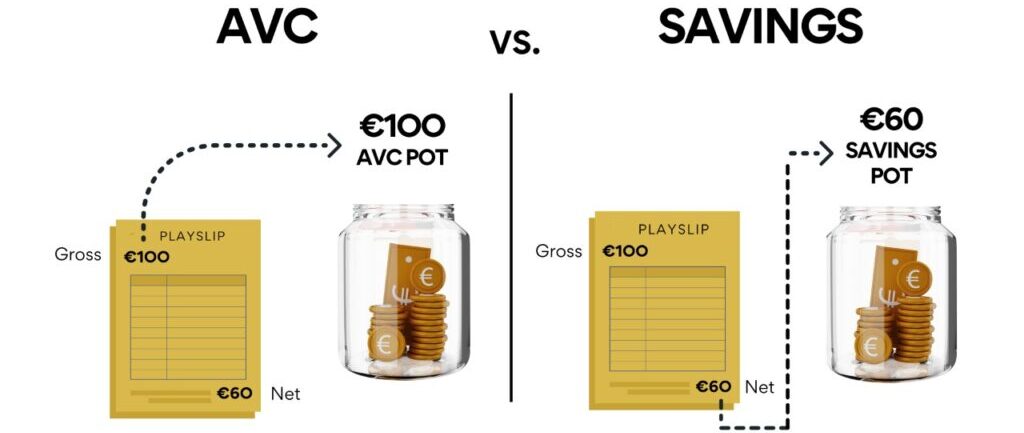
The info-graphic below compares an employee on a marginal rate of tax and the difference between contributing €100 of his Gross (pre tax) wages into an AVC vs a Savings plan.
As you can see from above, the AVC contributions are made on the employee’s gross (pre-income tax) earnings of €100 as compared to his net income (post income tax) of €60 with a savings plan. (Please note the above example ignores charges).
The extra €40 that goes into your AVC due to the relevant tax reliefs can have a hugely positive impact on your fund over a long period of time.
The infographics below compare an employee, who is in the 40% income tax bracket, contributing the same gross wages (€100) to both an AVC and a Savings Plan on a weekly basis over a 5-year period.
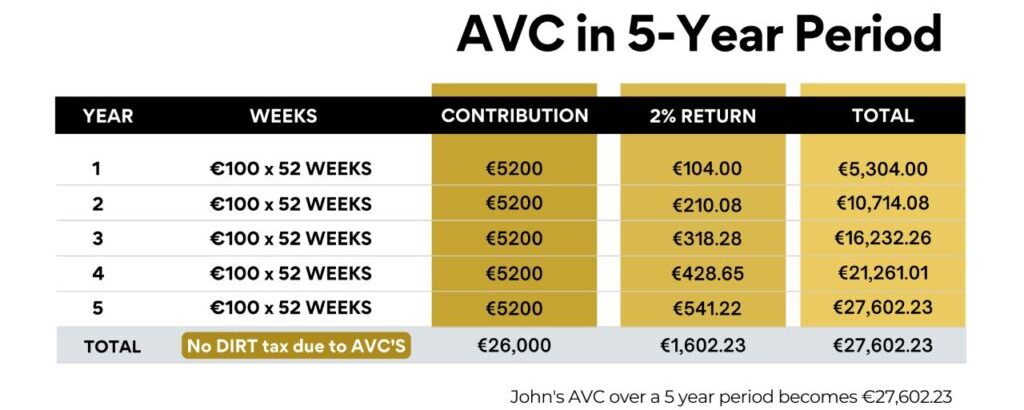
Savings IN 5 Year period
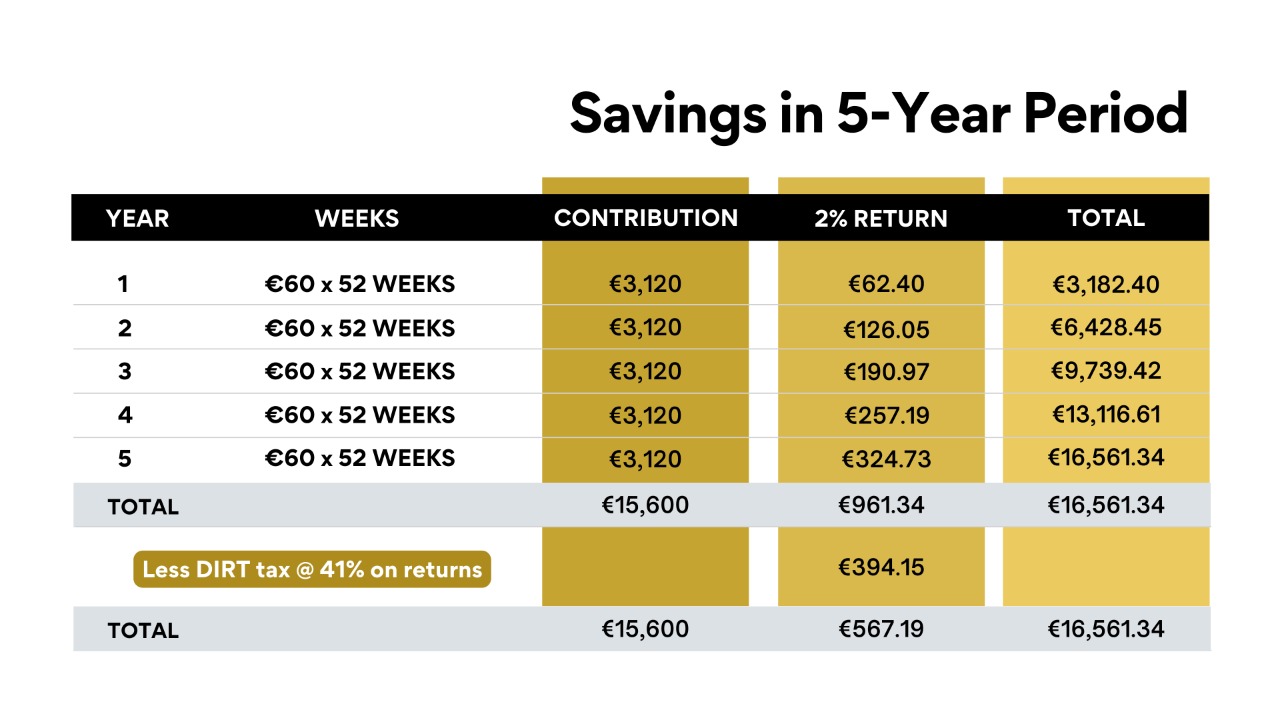
Example 2
As John’s contributions into his savings is (post income tax), his contributions are only €60 per week.
AVC And Saving
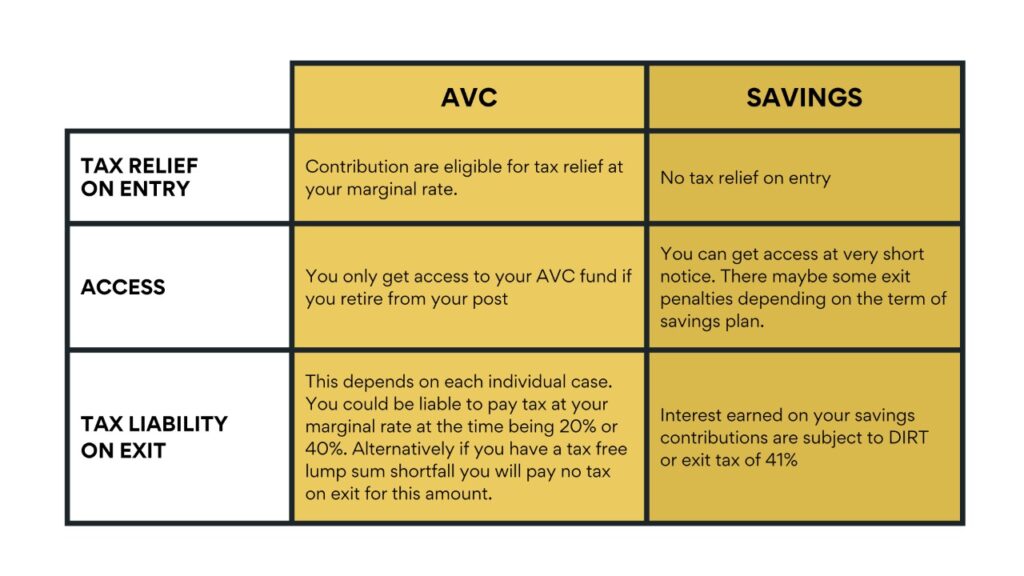
Example 3
The table below shows a summary of the differences between an AVC and Savings.
Public Sector AVC
If you are a public sector employee, AVCs are a very popular form of savings. Please click on the button below which goes into more detail about Public Sector AVCs.
Trustindex verifies that the original source of the review is Google. I've had an excellent experience with M M Advisory. Their professionalism was evident from the very beginning, and they responded to all of my queries promptly and efficiently. The team provided clear, informative advice that made everything easy to understand, giving me confidence throughout the process. They were knowledgeable, approachable, and always willing to take the time to explain things thoroughly. I would highly recommend M M Advisory to anyone looking for reliable, professional, and responsive financial advice and support.Posted on GoogleTrustindex verifies that the original source of the review is Google. We would like to thank Money Maximizer advisors & the team ( specially Cris) for all the help and support throughout the application process. She and the team guided us through the eacj steps of the process and helped us secured the mortgage. We are greatful and thankful for allof the hard work we sincerely appreciate. Thank you Cris and all the team.Posted on GoogleTrustindex verifies that the original source of the review is Google. A huge thank you to Ruairí and Olga for all their help and support in guiding us through what was a complex process. They were excellent to deal with from start to finish - professional, knowledgeable, patient and always available to answer our questions. They explained each step clearly and made sure we understood what was required, which gave us great peace of mind throughout. We really appreciated their guidance, attention to detail and commitment to helping us get the best outcome. I would have no hesitation in recommending Ruairí, Olga and Money Maximising Advisors to anyone looking for expert financial or mortgage advice.Posted on GoogleTrustindex verifies that the original source of the review is Google. Jack and Anastasia are absolutely amazing, we just completed our mortgage with the help of both Jack and Anastasia. They both made the whole process so smooth and quick we cannot thank them both enough and would certainly recommend them. Louise & JamesPosted on GoogleTrustindex verifies that the original source of the review is Google. I recently worked with Mayank and the team at Money Maximising Advisors, and they made the home-buying process so much easier for me. Their professionalism and expertise stood out from the start. They were always available when I needed help and responded quickly to any questions I had. Their guidance on mortgages and interest rates was incredibly helpful. I would highly recommend them to anyone looking to purchase a home
Get in touch with us
To schedule a call with one of our Qualified Financial Advisors.